The Physics of Emulsions: Interfaces, Droplet Jamming and Phase Inversion
Why oil and water want to separate, why mayonnaise holds a peak at 85 percent oil, and why a beurre blanc is made to order and never held hot
Members only · $10 a month
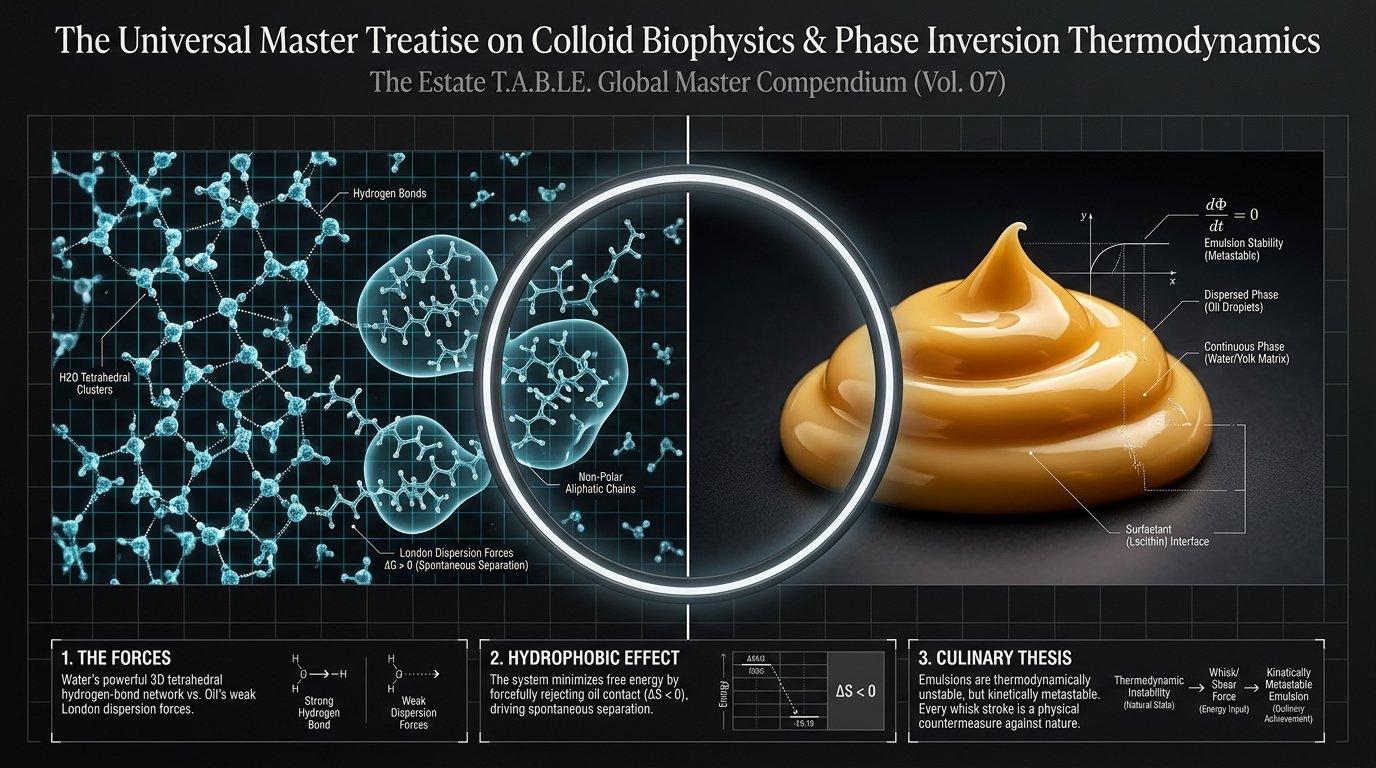
Every mayonnaise, hollandaise, vinaigrette and beurre blanc is a metastable dispersion that nature is trying to break. This module works the numbers (the 1,500 square meters of interface in one cup of sauce, Laplace pressure, Stokes' Law creaming, random close packing at 64 percent oil), shows how egg yolk, mustard, gelatin, aquafaba and xanthan each hold droplets apart, traces the phase inversion that turns butter into a sauce, and sets the temperature windows, Food Code limits and rescue steps a working kitchen needs. It is a study of the physics: how to make, hold and repair these sauces safely is stated in plain steps beside it.
- Interfacial Energy & Laplace Pressure
- Stokes' Law & Creaming
- Egg Yolk Fractions & Salt
- Droplet Packing & Jamming
- Butter Phase Inversion
- Thermal Windows & the Food Code
- Mustard, Aquafaba & Xanthan
- Failure Diagnosis & Rescue
How many times have you followed a recipe to the letter and still not known why it worked, or why it didn't?
This module is the why. The guides, flashcards, quiz, audio, video and study materials are for members, with your progress saved to your account. Membership is $10 a month, or $80 a year ($40 less than paying monthly), plus any sales tax that applies. Cancel online, any time, in one click.
Not sure yet? Read the free module first: Modern Lipidology: The Full Picture on Heart Disease