Brassica Biochemistry and Wasabi Myrosinase Activation
Why wasabi and mustard have no heat until you break them, and how timing, tools, temperature and acid decide how much you get
Members only · $10 a month
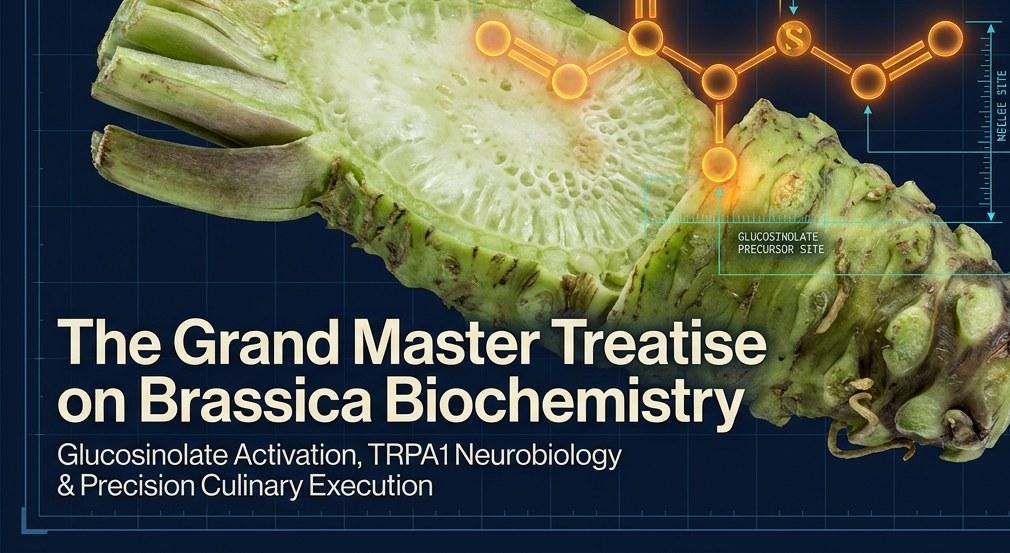
Intact wasabi, horseradish and mustard seed are mild. Their heat is made on demand: grating or chewing lets the enzyme myrosinase meet its glucosinolate and water, and a spontaneous rearrangement then releases allyl isothiocyanate, the vapor that fires the TRPA1 nerve channel in the nose. This module follows that reaction from the cell wall to the nerve, then turns it into kitchen rules: the sharkskin grater and the 15-minute wasabi clock, cold water before vinegar for mustard, why cooked broccoli can be rescued with raw mustard powder, and the food-safety limits for raw fish, cold holding, house mustards and mustard oil.
- The Mustard Oil Bomb
- Glucosinolates and Myrosinase
- Allyl Isothiocyanate and TRPA1
- Wasabi, Horseradish and Mustard Compared
- Grating Tools and the 15-Minute Wasabi Clock
- Cold Hydration and Timed Acidification
- Sulfur Off-Odors and the Mustard Rescue
- Raw Fish, Cold Holding, Allergens and Mustard Oil
How many times have you followed a recipe to the letter and still not known why it worked, or why it didn't?
This module is the why. The guides, flashcards, quiz, audio, video and study materials are for members, with your progress saved to your account. Membership is $10 a month, or $80 a year ($40 less than paying monthly), plus any sales tax that applies. Cancel online, any time, in one click.
Not sure yet? Read the free module first: Modern Lipidology: The Full Picture on Heart Disease